Shiv and the Grasshopper
The Jungle BookShiv and the Grasshopper is a lullaby and creation song within the story of Little Toomai. Sung by Little Toomai’s mother while she puts his younger brother to sleep, it imagines Shiv distributing the world’s provisions and destinies among all living beings. Its decisive idea is that no creature is outside the order of creation: even the tiny being hidden beneath Parbati’s heart has been remembered and given a place.
Form and Narrative Setting
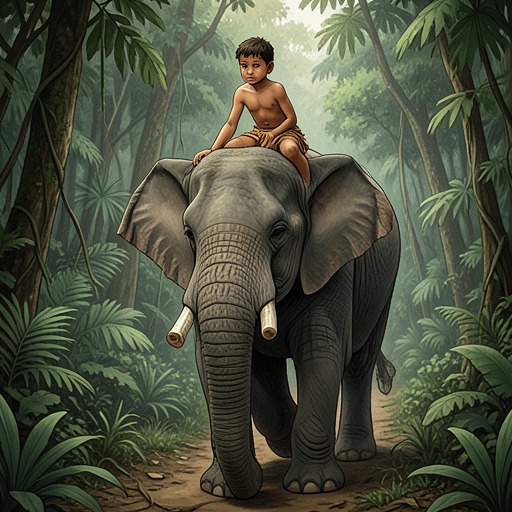
The song appears during the night before Little Toomai follows Kala Nag into the Garo Hills. Little Toomai has been left among the elephant fodder, beating a borrowed tom-tom because Petersen Sahib has spoken to him, while the newly captured elephants strain at their ropes and trumpet. From the camp hut comes his mother’s old song about Shiv, a soothing domestic sound set against the tension of the elephant camp. The lullaby therefore links household care with the larger, dangerous world of animals, hunters, and the night journey that will follow.
The text identifies the song as an inherited one, described as an old, old song about the great God Shiv, who once told all the animals what they should eat. Its narrative is not presented as a private invention but as remembered folk knowledge carried through maternal singing. The mother’s voice gives the creation tale an intimate scale, while the claims made by the song extend across the whole living order.
Shiv’s Distribution of the World
The opening presents Shiv as the power who poured out the harvest and made the winds blow, seated at the threshold of a remote sacred past. He gives each being a portion consisting not only of food but also of work and fate. The song consequently treats existence as an allocation: every creature receives a fitting share, and the world is understood through the relationship between body, environment, labor, and destiny.
The distribution proceeds through concrete pairings. The camel receives thorns, the cattle receive fodder, and the human mother receives a heart for the sleepy child. The arrangement places nourishment beside affection and makes maternal care part of the same cosmic economy as animal sustenance. Later, wheat is assigned to the rich, millet to the poor, and broken scraps to holy men who beg from door to door. The song thus includes social difference within its catalogue, moving from species and food to human class, religious vocation, and unequal portions.
Animals, Danger, and Fate
The song also assigns forms of violence and death. The tiger receives battle, while the kite receives carrion. These pairings do not describe a peaceful creation in which every creature shares the same condition; they establish a world in which predation, combat, and scavenging are also allotted places. The animal kingdom is therefore organized by distinct roles, and danger is not an accidental interruption but part of the fate given to particular creatures.
This logic resonates with the wider animal narratives surrounding the song. Baloo teaches Mowgli the Law of the Jungle as a system of permissions, boundaries, and reciprocal warnings; seals confront the killing grounds at Novastoshnah; Rikki-tikki-tavi fights the cobras in the bungalow at Segowlee cantonment; and the elephants gather beyond human knowledge in the Garo Hills. Against these different scenes, the lullaby offers a folk explanation of why creatures occupy different places in the world, while the surrounding stories show that those places can also become sites of conflict, cruelty, and resistance.
The Grasshopper and the Smallest Life
The song’s central reversal comes when the distribution appears to be complete. Parbati, described in the song as a thief, laughs and asks whether one among a million mouths has been left unfed. Shiv answers that all have received their part, including the little one hidden beneath her heart. The hidden creature is then drawn from her breast, and the song identifies the smallest life as the grasshopper.
This ending changes the meaning of the earlier catalogue. The song is not merely a list of large, visible creatures and their obvious functions. Its final test is whether creation remembers what is minute, concealed, and easy to overlook. Shiv’s answer affirms that cosmic order reaches even the least conspicuous being. The grasshopper consequently becomes the emblem of completeness: a creature apparently too small to matter is precisely the creature whose inclusion proves that no portion has been forgotten.
Cultural and Thematic Significance
As a lullaby, Shiv and the Grasshopper comforts a child by placing sleep within an ordered universe. As a creation story, it explains food, labor, social position, danger, and fate through divine apportionment. Its movement from harvest and wind to camel, cattle, mother, rich and poor, tiger, kite, and finally the grasshopper gives the song a widening and then narrowing rhythm, ending not with the grandest creature but with the smallest.
The song also supplies a cultural frame for the book’s recurring practice of giving animals voices, songs, laws, and remembered histories. Animal life is not treated as mute background: it is classified, sung, witnessed, and made part of moral knowledge. The maternal performance makes that knowledge portable, passing it from one generation to another while the surrounding camp prepares for the elephants’ secret movement. Its final assurance is both theological and narrative: every life has a share, even when that life is hidden from ordinary sight.